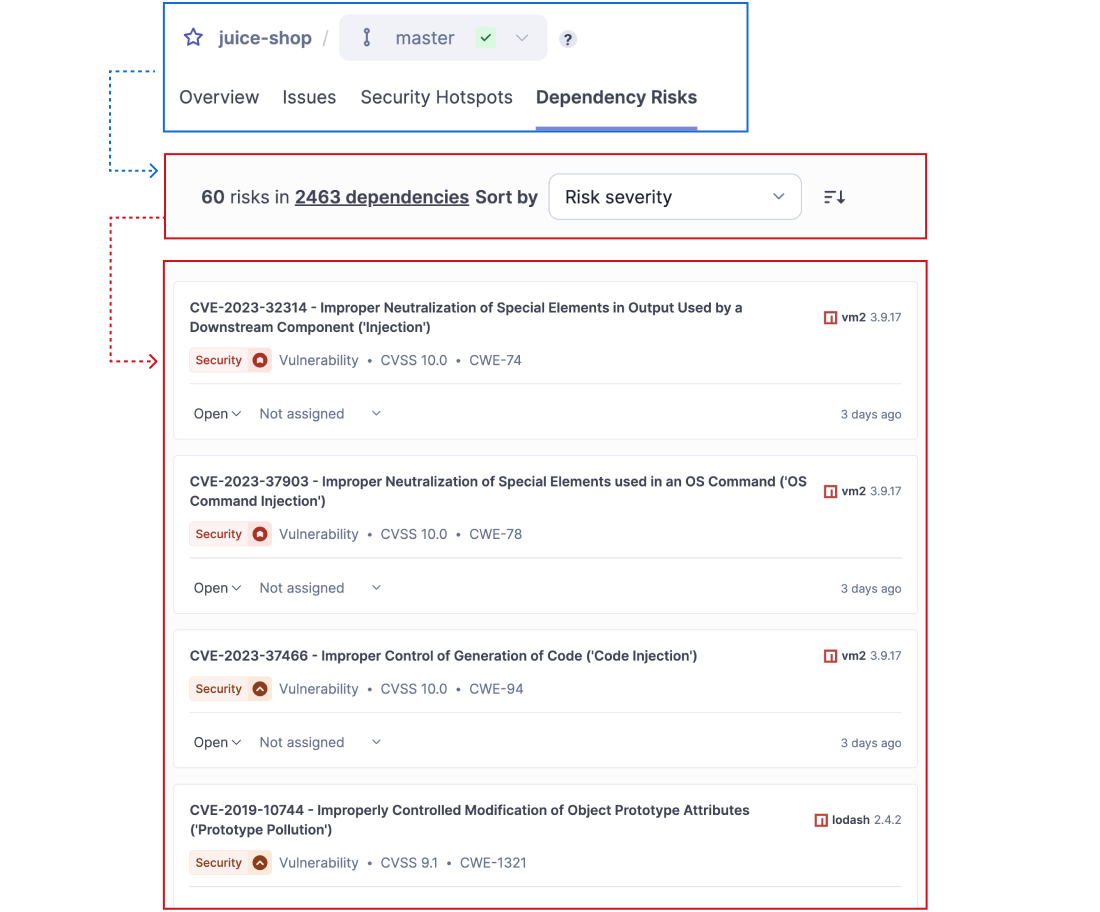


SonarQube가 소프트웨어 공급망을 보호하는 방법
SonarQube는 로직, 보안 종속성 및 자격 증명을 위한 통합 코드 검증 계층을 통해 공급망을 보호합니다. 자동화된 품질 게이트를 통해 모든 코드가 Git 히스토리에 기록되기 전에 프로덕션에 배포할 준비가 되어 있고 안전한지 확인합니다.

타사 종속성
SCA는 오픈 소스 라이브러리에서 알려진 보안 취약점(CVE)과 악성 패키지를 식별하고 라이선스 준수를 강제합니다.

시크릿 및 자격 증명
자동화된 탐지 기능을 통해 IDE 내 또는 SonarQube 시크릿 CLI를 통해 하드코딩된 시크릿, 토큰 및 비밀번호가 Git 히스토리에 기록되기 전에 이를 포착합니다.

타사 라이브러리
고급 SAST는 코드가 오픈 소스 라이브러리와 상호작용하는 방식을 분석하여 복잡한 인젝션 취약점을 발견합니다.

보안 파이프라인 워크플로우
SonarQube는 잘못 구성된 GitHub Actions 및 Azure Pipelines를 감지합니다. 고정되지 않은 액션과 스크립트 인젝션을 조기에 식별함으로써, 침해 사고가 발생하기 전에 공격자가 워크플로우를 악용하는 것을 막을 수 있습니다.

Java

JavaScript

TypeScript

Python

C#

C

C++

GO

Kotlin

Scala

Ruby

Rust

Kubernetes

Terraform

CloudFormation

Docker

NPM

Apache Maven

Conan

NuGet
SonarQube의 공급망 보안이 업계에서 독보적인 이유는 무엇일까요?

의존성 인식 분석
독립형 SCA 도구와 달리, Sonar는 코드에서 타사 라이브러리로 이어지는 데이터 흐름을 추적하여 기존 스캐너가 놓치는 숨겨진 보안 위험을 찾아냅니다.
예방 중심의 시크릿 탐지
Sonar 시크릿 CLI 및 SonarQube for IDE를 사용하여 시크릿을 원천에서 차단함으로써, 비용이 많이 드는 자격 증명 교체나 Git 히스토리 재작성의 필요성을 없앱니다.

통합 거버넌스
중앙 집중식 품질 게이트를 통해 품질과 보안을 단일 워크플로로 통합하여, 플랫폼 엔지니어링 및 보안 팀을 위한 단일 정보 소스를 제공합니다.
GitHub Copilot
자세히 알아보기
Google Gemini Code Assist
자세히 알아보기
Amazon Q
자세히 알아보기

What is software supply chain security and why does it matter?
Supply chain security involves securing everything that goes into your software, including first-party code, third-party libraries, and configuration files. It is critical because attackers increasingly target the "weak links" in open-source dependencies or exposed secrets to gain unauthorized access to enterprise systems.
How does SonarQube differ from traditional SCA tools?
Most SCA tools only provide a list of vulnerabilities found in your dependencies. SonarQube goes further by integrating SCA with Advanced SAST. This allows you to see if your code actually interacts with a vulnerable library, reducing noise and helping developers prioritize the fixes that actually reduce risk.
What are the most common types of software supply chain attacks?
Common software supply chain attacks include compromising popular open source packages, inserting malicious code into build scripts or CI/CD pipelines, tampering with artifacts in registries, and abusing unverified third‑party services.
In dependency‑focused attacks, adversaries may publish malicious updates to widely used libraries or exploit known vulnerabilities like Log4Shell, instantly impacting thousands of applications that transitively rely on the affected component.
Other attack patterns focus on the development and delivery process itself—abusing compromised developer credentials, manipulating build environments, or poisoning artifacts so that every downstream consumer inherits the compromise.
Because these attacks exploit existing trust relationships, they can remain undetected for long periods and are often discovered only after widespread damage has occurred, making prevention and early detection critical.
What are best practices to improve software supply chain security?
Strong software supply chain security starts with comprehensive inventory and governance: maintain an up‑to‑date view of all software components, enforce clear policies for third‑party usage, and conduct regular vulnerability scanning across your environment.
Complement this with proactive vendor and OSS evaluation, continuous monitoring and threat intelligence, and a well‑defined incident response plan so you can react quickly when high‑profile vulnerabilities or breaches emerge.
At the development level, integrate security into the SDLC with code review, automated testing, and developer training that emphasizes code quality and secure use of dependencies.
Adopting frameworks like SLSA or related industry standards helps structure your efforts, while focusing on new code quality—sometimes described as quality at the source or a focus on new code—lets you enforce strong gates on every change without being blocked by legacy issues.