
初回からクリーンなプルリクエスト
コードがレビューに回される前に、AIによる日常的なミスが修正されます。レビュー担当者は、クリーンアップではなく、ロジックやアーキテクチャの検討に時間を費やすことができます。
Claude Code

Devin & Windsurf

Google Gemini CLI
Cursor
GitHub Copilot
OpenAI Codex CLI
MCP-compatible clients
基本的なコードチェッカーは1つのファイルしか確認しません。コードベースの異なる部分が相互作用する際に発生するバグを見逃してしまいます。
CIが問題を検知する頃には、開発者はすでに次の作業に移っています。修正のために作業を戻すには、時間、集中力、そして勢いが失われます。
シニアエンジニアやセキュリティチームは、アーキテクチャやロジックに集中する代わりに、AIによる日常的なミスを修正するためにレビューサイクルを浪費しています。
共通の基準がなければ、複数のAIコーディングツールを使用するチームは、同じコードベース内で一貫性のないコード品質に直面することになります。
問題はコード生成中に検出・修正されます。開発者が作業を中断して修正しなければならない数時間後ではありません。
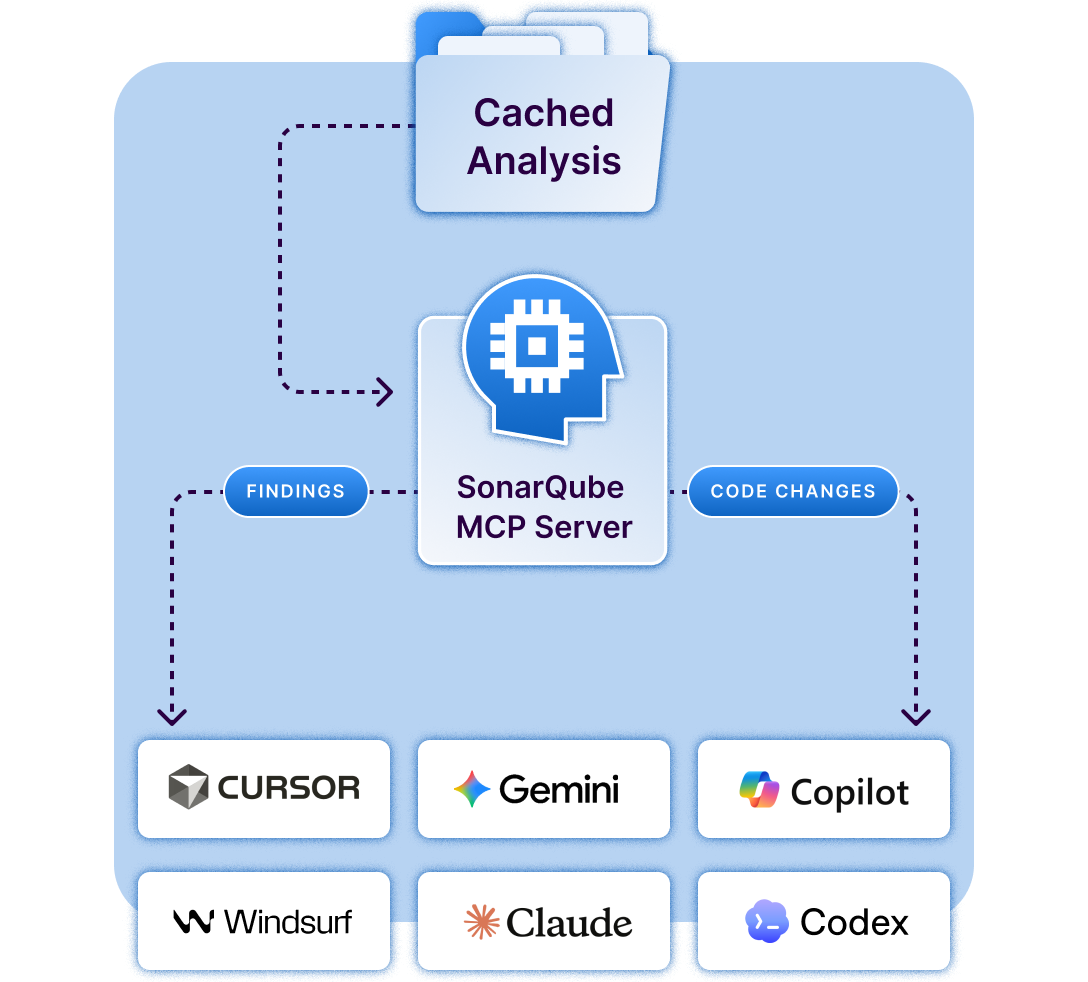
過去のCIビルドからキャッシュされたデータを活用し、コードベース全体の関連性を把握します。単一ファイルのチェッカーでは見逃されがちな、ファイル横断的なバグを検出します。
新たなルールを定義する必要はありません。Agentic Analysisは、チームがSonarQubeですでに適用している品質プロファイルを、チーム内のあらゆるAIツールに適用します。
脆弱性、信頼性の問題、保守性の問題、漏洩した機密情報のチェックを行います。単なるセキュリティやスタイルチェックにとどまりません。
SonarQube MCPサーバーを介して、Cursor、GitHub Copilot、Claude Code、Windsurf、Gemini CLI、およびMCP互換のあらゆるワークフローと連携します。
チーム内のあらゆるAIコーディングツールに対して、単一の検証基準を適用します。開発者が異なるアシスタントを使用しても、コード品質にばらつきが生じることはありません。
Sonar Context Augmentationは、AIエージェントが1行も記述する前に、プロジェクトの品質ルールとコードのコンテキストを提供します。
Cursor、Copilot、Claude Code、またはMCP互換のツールなど、お使いのAIコーディングツールが通常通りコードを生成します。
Agentic Analysisは、プロジェクト全体のコンテキストを活用し、SonarQubeの品質プロファイルに基づいてコードを自動的にチェックします。この処理は数秒で完了します。
AIは、Sonarの具体的かつルールに基づいた検出結果を活用して、自身のミスを修正し、再検証を行います。これらは、開発者がコードを目にする前に完了します。
コードがレビューに回される前に、AIによる日常的なミスが修正されます。レビュー担当者は、クリーンアップではなく、ロジックやアーキテクチャの検討に時間を費やすことができます。
コード品質とコードセキュリティの向上にチームが既に活用している、Sonarの分析基盤をそのまま活用しています。
ローカルなヒューリスティックだけに頼るのではなく、SonarQubeのコンテキスト、ベースライン、基準をエージェントのループに取り込みます。
AIによって生成された日常的な問題を、レビュー担当者が後処理する段階になる前に、その時点で検出して修正します。
Agentic Analysisがチームの既存のAIワークフローにどのように組み込まれるかをご覧ください。新しいツールの習得も、新しい基準の定義も必要ありません。
SonarQube Agentic Analysis is a real-time code verification service from Sonar. It connects AI coding tools — such as Cursor, GitHub Copilot, and Claude Code — to SonarQube's analysis engine through the Model Context Protocol (MCP). While the AI is writing code, it automatically checks its own output against your team's SonarQube quality and security standards, finds issues, fixes them, and re-checks — all before the developer opens a pull request.
Linters check one file at a time and miss bugs that require understanding how different parts of a codebase interact. SonarQube Agentic Analysis uses context from your last full SonarQube CI scan to understand your entire project — catching cross-file issues that single-file tools miss. It also applies your team's full quality, security, and reliability standards automatically, not just basic syntax checks.
No. Agentic Analysis works alongside your existing CI/CD pipeline — it doesn't replace it. It adds an earlier verification step inside the AI's coding workflow, so fewer problems reach CI in the first place. Your CI pipeline remains the final authority on code quality.
No. Agentic Analysis uses Sonar's deterministic-first code analysis engine. Your code is checked using a systematic and deep code analysis, not processed by a generative AI. The results are consistent and explainable: every finding can be traced back. This is what makes Sonar's analysis trustworthy for compliance and enterprise governance.
No. Agentic Analysis automatically uses the quality profiles your team already has set up in SonarQube. There are no new standards to define or maintain. It applies the same standard to AI-generated code that you already enforce for all your code.
Agentic Analysis is built for engineering teams that already use SonarQube and are actively using AI coding tools. It is available to SonarQube Cloud customers. To get started, you need an active SonarQube Cloud paid account, at least one recent SonarQube project scan, and an MCP-compatible AI coding tool. Most teams are up and running in under an hour.
多くの重要な問題は、単一のファイルだけでは検出できません。単独で見れば正しく見える変更でも、非推奨のAPIへの依存、安全でない使用パターン、欠落した型関係、あるいはプロジェクト全体のロジックに起因している可能性があります。Agentic AnalysisはSonarQubeのプロジェクトコンテキストを活用し、信頼できるほど正確なフィードバックを迅速に提供します。