

TL;DR overview
- Managing technical debt in software development requires continuous visibility, automated code analysis, and quality gates to prevent shortcuts from compounding into slower delivery, higher defect rates, and escalating maintenance costs.
- Industry estimates put cumulative U.S. technical debt at over $1.5 trillion annually, with 20–40% of sprint capacity consumed by rework in affected teams.
- AI accelerates both debt creation and cleanup: 88% of developers report negative impacts like unreliable or duplicative AI-generated code, while 93% cite benefits in documentation, testing, and refactoring.
- Reducing development friction starts with treating debt as a measurable portfolio, integrating remediation into sprint cycles, and verifying all code, developer- or AI-written, against defined quality standards.
Technical debt has become one of the most persistent drags on software development teams. As organizations push to ship features faster (and increasingly rely on AI to do it) shortcuts in design, testing, and infrastructure pile up in ways that slow future progress and increase risk.
Managing this debt strategically is no longer optional. It's core to sustainable development, product quality, and business outcomes.
What is technical debt?
Technical debt describes the future cost of work that results from taking shortcuts today. These shortcuts, whether deliberate or accidental, show up in code, architecture, processes, and organizational habits.
In practical terms, technical debt is the cumulative cost of compromises in software design, code, data, and testing that make future change slower and riskier. Every line of code with unresolved issues, every skipped test, every undocumented dependency compounds over time—reducing agility, reliability, and scalability.
And while it's tempting to treat debt as a purely technical problem, it's deeply tied to business outcomes: higher maintenance costs, delayed releases, and lost opportunity to innovate.
What causes technical debt to accumulate?
Technical debt usually builds under pressure. Fast delivery cycles, resource constraints, and incomplete knowledge all contribute. Common triggers include:
- Business pressure for speed-to-market: Causes teams to defer noncritical refactoring.
- Legacy constraints: Outdated systems or frameworks prevent modernization.
- Skill or context gaps: Developers unknowingly introduce fragile patterns.
- AI-generated code: Creates what some call "AI debt"—inconsistent styles, duplicative logic, or hidden inefficiencies introduced without adequate review.
In most organizations, the driver isn't negligence, rather, it's a tradeoff. But without a clear payback plan, that tradeoff silently compounds, eroding maintainability and confidence over time.
AI is making technical debt worse—and better—at the same time
According to Sonar's State of Code Developer Survey, AI's relationship with technical debt is complicated. It's both a cleanup tool and a new source of messy, hidden problems.
The negative side
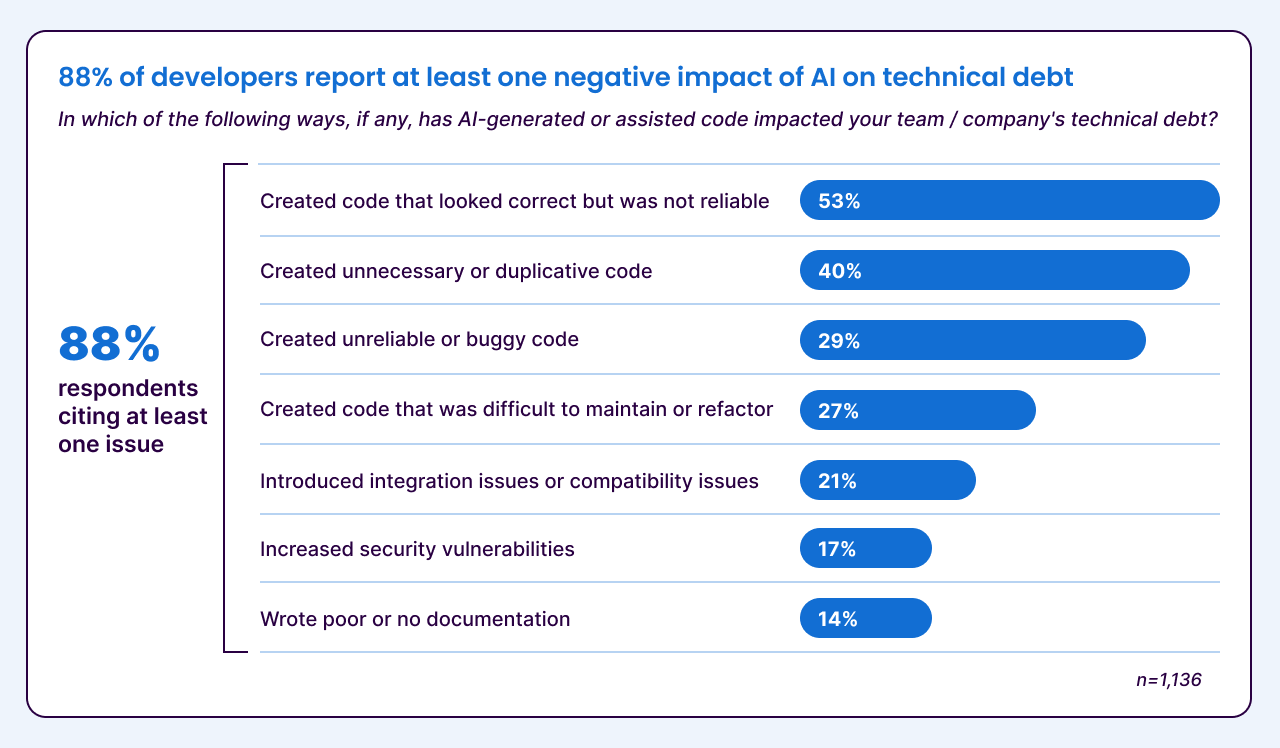
Nearly all developers surveyed (88%) report at least one negative impact of AI on their technical debt. The most common issues:
- 53% say AI creates code that looks correct but isn't reliable, a particularly dangerous problem because it creates a false sense of security and may cause teams to skip thorough review
- 40% say AI increases technical debt by generating unnecessary or duplicative code
- 29% report AI-generated code that is unreliable or buggy
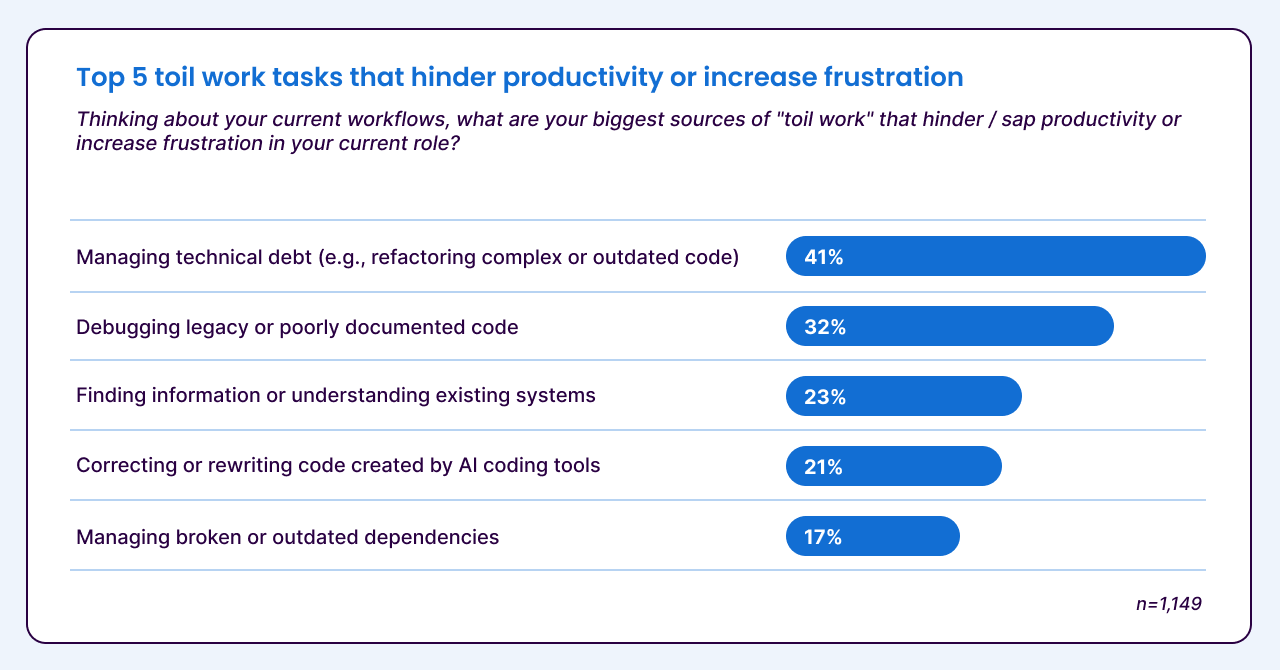
This matters because "managing technical debt" is already the number one source of toil for core development tasks, with 41% of software developers placing it in their top five frustrations. AI, if unmanaged, pours fuel on an existing fire by generating a high volume of code that's deceptively unreliable.
Sonar's own LLM personality research confirms this: LLMs have inherent tendencies to create verbosity, complexity, and unnecessary technical debt when writing code.
The positive side
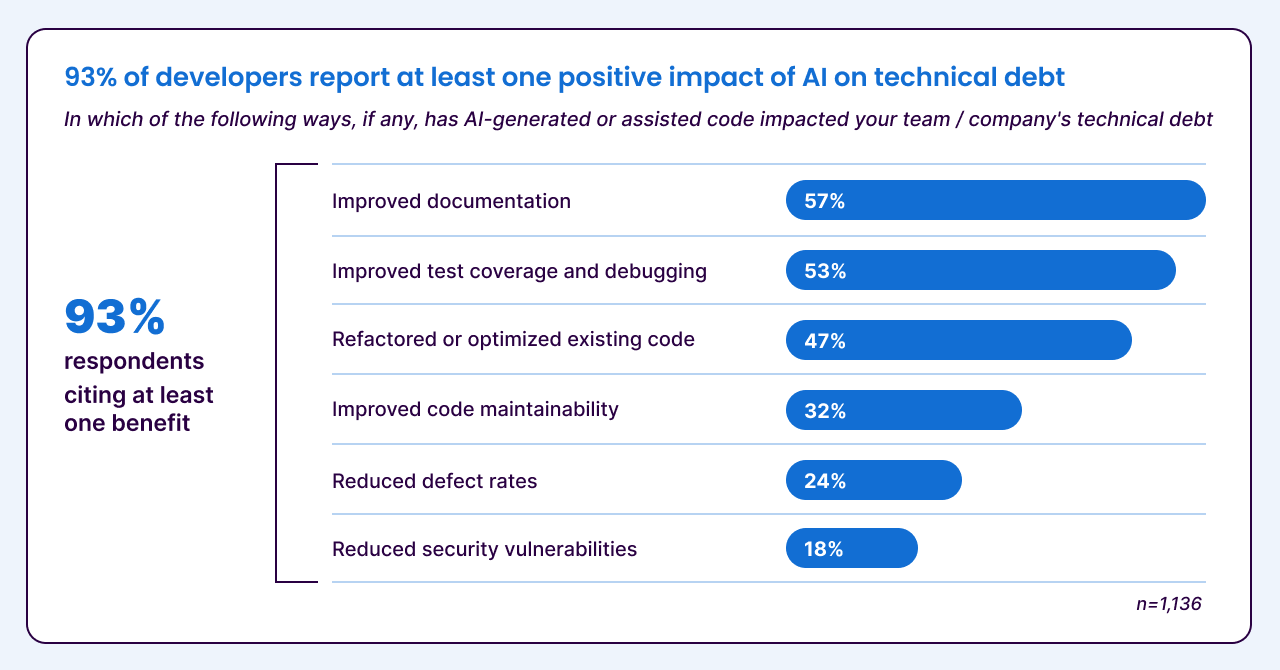
Despite these issues, 93% of developers also report at least one positive impact from AI on technical debt. Developers are clearly using AI to tackle the most tedious parts of debt management:
- 57% cite improved documentation as a key benefit
- 53% report improved test coverage and debugging
- 47% say AI has helped refactor or optimize existing code
Senior software developers especially value AI's documentation capabilities, with 65% of developers with over 20 years of experience citing improved documentation as a top benefit.
The bottom line
AI isn't a "fix technical debt" button. It can help developers clean up old messes (like documentation and testing) but could also create new, more subtle messes in the process (like unreliable or duplicative code). The teams that come out ahead will be those that pair AI speed with systematic code verification.
The cost and impact of technical debt
Industry estimates put cumulative U.S. technical debt at over $1.5 trillion annually. For mid-sized companies, that translates into millions in lost productivity and maintenance rework. When left unchecked, technical debt impacts every part of the business:
- Delivery speed: Slower development and testing cycles
- Quality: More defects and production bugs
- Financials: Escalating maintenance and opportunity costs
- Culture: Frustrated teams and higher attrition
The longer debt sits unaddressed, the harder and more expensive it becomes to resolve. Sonar's developer survey found that 41% of developers rank managing technical debt as a top source of toil, and 53% say AI-generated code looks correct but isn't reliable. This only compounds the problem by adding debt that's harder to detect. Without systematic code verification, faster output just accelerates accumulation.
Managing and reducing technical debt
Technical debt can't be eliminated overnight, but it can be managed with the right approach. The teams that do this well treat debt as a measurable portfolio, blending technical and business insight when prioritizing what to fix first.
Core practices of successful development teams
- Continuous visibility: Integrate automated code analysis into your CI/CD pipeline to monitor and manage code debt in real time. Tools like SonarQube surface issues across reliability, maintainability, and security, giving teams a single view of codebase health.
- Tackle debt in backlogs: Track and prioritize debt items alongside features, making them part of sprint planning rather than an afterthought.
- Quality gates: Prevent new debt from entering the codebase by enforcing standards at the PR level. SonarQube's quality gates compare analysis results against your defined quality profiles and block merges that don't meet the bar, creating an automated safety net for every commit, whether written by a developer or generated by AI.
- Verification for AI-generated code: With AI writing a growing share of production code, systematic code verification is no longer a nice-to-have.
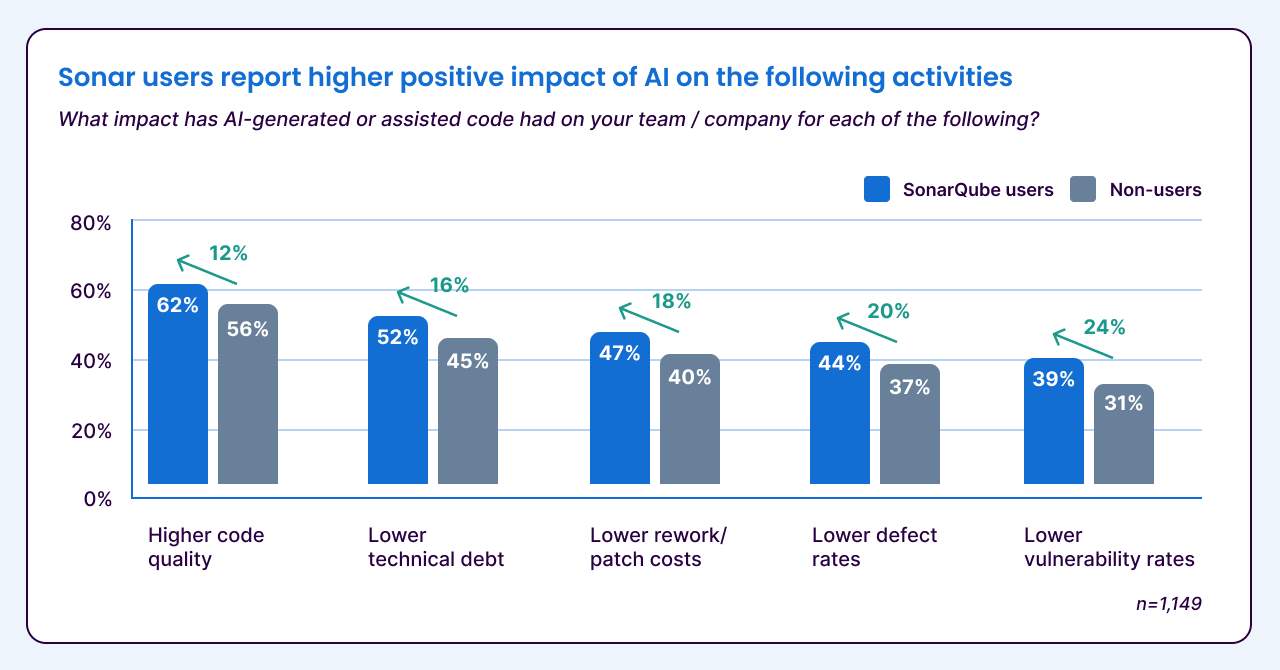
Sonar's State of Code Developer Survey found that SonarQube users are more likely to report stronger positive impacts on code quality, technical debt, rework costs, defects , and vulnerabilities than non-users. Having a code verification process in place is key to turning AI's speed into real-world quality improvements.
Remediation and continuous monitoring
Addressing technical debt effectively requires an incremental, transparent process:
- Discover and map debt through automated tools and team input
- Classify and score items by type, severity, and risk
- Quantify code remediation effort relative to rebuild cost
- Prioritize high-interest areas first
- Integrate payback into sprint cycles for consistent progress
- Continuously monitor via dashboards, updating policies as practices evolve
The SonarQube Remediation Agent (now available in beta for SonarQube Cloud Teams and Enterprise accounts) helps teams automatically fix identified issues. Teams can make this process both continuous and predictable. Every fixed issue refines context for the next cycle, making the system continuously smarter.
Taking control of technical debt
Technical debt isn't going away, and AI is making the stakes higher. With 42% of committed code now AI-generated or assisted and that share projected to reach 65% by 2027, the volume of code entering your codebase is accelerating far faster than most teams can manually review. The organizations that treat debt as a manageable portfolio—measured, prioritized, and systematically paid down—will ship faster and more confidently. Those that don't will watch shortcuts compound into outages, attrition, and missed opportunities.
The path forward isn't to slow down. It's to verify as you go. Integrate automated code analysis into your CI/CD pipeline, enforce quality gates on every commit, and make remediation a sprint-level habit, not a quarterly fire drill. Whether your code is written by a developer or generated by AI, the standard should be the same: clean, reliable, and production-ready.
Want to learn more about how AI is impacting development? Read the full report.
