Software maintainability
Ensure that your codebase can be easily read, understood, modified, repaired, and enhanced at any time by any developer. Enable developers to design code that is scalable to manage growth and change which allows for easier additions, features and improvements.
Why is code maintainability important?
By some estimates, code maintenance accounts for more than 90% of project costs. If your codebase is hard to maintain, efforts to address issues can become increasingly costly and time-consuming. This leads to stagnated velocity on feature delivery that impacts your overall success.

Secure, high quality code makes maintenance easy
Minimal code maintenance leads to an optimized development workflow that supports more maintainable software.

Increase team velocity
When code is easy to understand, updates and new projects happen faster.

Focus on what's new and interesting
Spend less time figuring out how someone else’s code works and more time working on interesting problems.

Embrace life-long learning
Whether you're new to a language or just polishing your technique, Sonar makes every Issue a teachable moment embedded within your workflow.

Promote unity
Personal preference gives way to team wisdom when you enshrine your coding standards in your quality profiles.
The right feedback, at the right place, at the right time
Get advance warnings of potential pitfalls with guidance to mitigate code smells when they’re raised early in the development process.
SonarQube for IDE in your corner
Add SonarQube for IDE to your IDE for the earliest possible feedback. With SonarQube for IDE to catch new issues as you code, no one will ever see your mistakes. Plus, it’s free and open source!

Maintain a high code standard with PR analysis
Proactively tackle issues with pull request analysis prior to peer review with Commercial Editions of SonarQube Server or SonarQube Cloud.


Code metrics that are easy to understand and present
Cognitive complexity
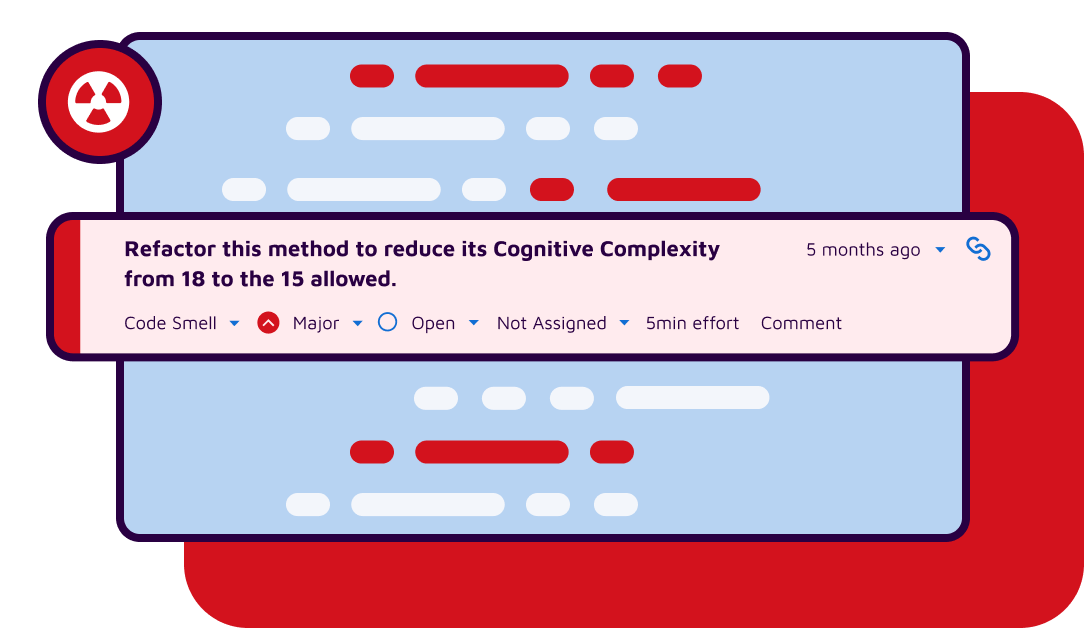
Sonar invented Cognitive Complexity to detect issues when code is structured in a way that is hard to understand. Complex code is more likely to be buggy and confusing which leads maintainers to add new bugs.
Every language has best practices. Sonar helps you follow them.


Ready to sustain maintainable software?
What is software maintainability, and why does it matter?
Software maintainability is the ease with which you can repair, improve, modify and extend code over time. On this page, it’s framed as ensuring your codebase can be easily enhanced at any time by any developer, so teams can safely evolve systems as requirements emerge.
High maintainability underpins sustainable development: code that’s easier to work with reduces friction whenever you need to fix a defect, add a feature, or adapt to new architecture and technology.
Maintainability also has a direct business impact. By some estimates, code maintenance accounts for more than 90% of project costs, and if your codebase is hard to maintain, addressing issues becomes increasingly costly and time-consuming.
Unmaintainable code slows delivery and leads to stagnated velocity on feature work, which ultimately affects your ability to compete and deliver value to users.
Investing in practices and tools that improve maintainability—like focusing on new code quality from the start—helps control long-term costs while keeping teams productive.
How does SonarQube help improve software maintainability?
SonarQube improves maintainability by continuously analyzing your codebase against rules that reflect best practices for security, reliability, and maintainability, then surfacing issues as actionable items in its dashboards.
Managing code maintainability as you develop, guided by SonarQube’s code verification results, leads to an optimized development workflow that supports more maintainable code overall.
Developers get understandable metrics and issue explanations that turn every finding into a learning opportunity embedded directly in their workflow.
SonarQube also helps teams focus on new code so they don’t drown in legacy problems. By checking each code change against defined coding standards, maintainability is encouraged from the start and continually as developers work, preventing additional maintainability issues from entering the system.
Over time, this approach steadily raises the maintainability of the overall codebase without requiring massive refactoring projects, improving it more and more over time, making it easier and safer to evolve software.
Which code metrics does SonarQube use to assess maintainability?
The maintainability page highlights three core metric areas: complex code, duplication risk, and uncovered code.
Sonar introduced the Cognitive Complexity metric to detect code that’s structured in ways that are hard to understand; complex code is more likely to be buggy and confusing, which in turn leads maintainers to introduce new defects when making changes.
Duplicate detection identifies multiple copies of the same logic so you can consolidate them and avoid having to fix the same bug in many places.
Unit test coverage is another key maintainability signal: Sonar surfaces where your tests are strong and where coverage is weak, so you can change code with confidence—if tests still pass, you know you haven’t broken existing behavior.
All of these metrics roll up into SonarQube's broader software qualities model—security, reliability, and maintainability—to show how each issue affects long-term code health and help teams prioritize work that protects future development speed.
How do SonarQube for IDE and SonarQube Cloud support new code quality?
SonarQube for IDE is a free extension that plugs directly into your IDE to provide the earliest possible feedback while coding.
By catching new issues as you write code, it ensures that code maintainability standards are met before code is checked into the repository.
This is a textbook example of quality from the start: developers see issues in context and can fix them immediately, reinforcing good habits as they go.
SonarQube Cloud extends this focus on new code maintainability to the code repository and distributed teams by running automated code reviews in your CI/CD pipeline and governing results across repositories.
Every coding change is evaluated automatically, and quality gates enforce your coding standards so that substandard code does not progress through the CI/CD pipeline. Together, SonarQube for IDE and SonarQube Cloud enable a workflow centered on new code maintainability, preventing unmaintainable code from accumulating technical debt.
How does pull request analysis in SonarQube Server and SonarQube Cloud maintain a high code standard?
SonarQube Server and SonarQube Cloud automatically reviews code in every branch and pull request before peer review so teams can focus more time on innovation that catching and fixing late stage maintainability issues.
This means that when a developer opens a pull request, SonarQube automatically checks the changed code for maintainability issues, code smells, complexity, duplication, and test coverage gaps, then posts results back to the PR for reviewers and authors to see.
Reviewers can then focus discussions on design and business logic rather than manual defect hunting.
By making this analysis part of every branch and pull request, teams enforce their code quality and security standards for new code using quality gates to prevent substandard code from progressing through the CI/CD pipeline.
PRs that introduce unacceptable maintainability risks can be blocked or flagged for remediation before merge, reducing the chances that difficult-to-maintain code enters the main branch. Over time, this systematic focus on new code helps keep the entire codebase easier to evolve, with fewer surprises when developers revisit older modules.
How does improving maintainability with SonarQube impact team velocity and developer productivity?
Code that is maintainable and easier to understand leads to higher team velocity: when code is easy to grasp, updates and new features are completed faster.
Developers spend less time deciphering someone else’s work and more time solving meaningful problems and delivering value.
SonarQube’s insights turn each issue into a “teachable moment,” helping both new and experienced developers continuously improve their skills without leaving their normal workflow.
From a productivity standpoint, better maintainability reduces rework and firefighting. Automated code reviews and clear metrics reveal problem areas early, so teams can address issues while context is still fresh rather than months later under production pressure.
This systematic focus on new code maintability—ensuring every new change meets your standards—means that the codebase becomes progressively easier to work with, accelerating onboarding for new team members and enabling faster, safer iterations.
What role do unit test coverage and quality gates play in maintainable software?
Unit test coverage is highlighted on the page as a key factor in maintainability: with solid coverage, you can confidently make changes, knowing that if tests still pass you haven’t broken existing behavior.
Sonar surfaces where coverage is good and where it needs improvement, allowing teams to prioritize tests in areas that are risky, complex, or changed frequently. This gives maintainers a safety net when refactoring or adding features, lowering the cost of ongoing evolution.
Quality gates then translate these expectations into enforceable policies. By combining coverage thresholds with rules about complexity, duplication, and code smells, SonarQube ensures that new code meets an agreed standard before it can progress through the pipeline.
This drives maintainability from the start and keeps teams focused on new code—if a change fails the gate due to missing tests or poor maintainability, it must be fixed immediately rather than becoming tomorrow’s technical debt.
How does SonarQube’s Cognitive Complexity differ from traditional complexity metrics for assessing maintainable code?
Cognitive Complexity, invented by Sonar, was designed specifically to reflect how developers experience code complexity when they read and understand it.
Instead of relying purely on mathematical models, it focuses on how control structures, nesting, and flow affect a reader’s mental load, yielding scores that align more closely with how maintainable developers perceive a method or function to be.
On the maintainability page, this is summarized as detecting when code is “structured in a way that is hard to understand.”
This perspective is critical for maintainability because complex code is more likely to be buggy and confusing, which can cause maintainers to introduce additional bugs when they make changes.
By tracking Cognitive Complexity and encouraging teams to reduce it in new and modified code, SonarQube supports new code maintainability and keeps codebases readable and safer to evolve over time.
Is there a free way to start improving maintainability with SonarQube Community Build?
Yes. SonarQube Community Build offers essential analysis capabilities for maintainability, making it a strong starting point for small teams, open-source projects, and organizations beginning their code maintainability journey.
It provides core rules, metrics (including complexity, duplication, and coverage integration), and a central dashboard so you can visualize code health and identify areas to improve.
As needs grow, teams can upgrade from Community Build to commercial editions of SonarQube Cloud or SonarQube Server for advanced features like branch and pull request analysis, portfolio views, and expanded governance and security capabilities.
This path lets organizations adopt a focus on new code maintainability early, prove value, and then scale up their use of maintainability from the start to cover more projects, teams, and compliance requirements.
How does SonarQube support organization-wide coding standards and consistent code maintainability?
Sonar helps “promote unity” by replacing personal preferences with shared team wisdom codified in quality profiles—reusable collections of rules and standards that define how your organization expects code to look and behave.
These profiles ensure that every project is evaluated against the same expectations for security, reliability, and maintainability, regardless of who wrote the code or which language they used.
Because SonarQube analysis runs consistently in IDEs, CI/CD pipelines, and branch and pull requests, developers get the same guidance everywhere they work.
This reinforces organization-wide standards and keeps the emphasis on new code maintainability from the start: each new change is checked automatically, feedback is presented in a consistent format, and teams can track adherence across time and repositories.
The end result is a consistent maintainable code that remains understandable and extensible as your software and teams scale.