Gives AI coding agents the context and constraints they need when they write, verifies their output in real time, and provides immediate feedback when something needs fixing.
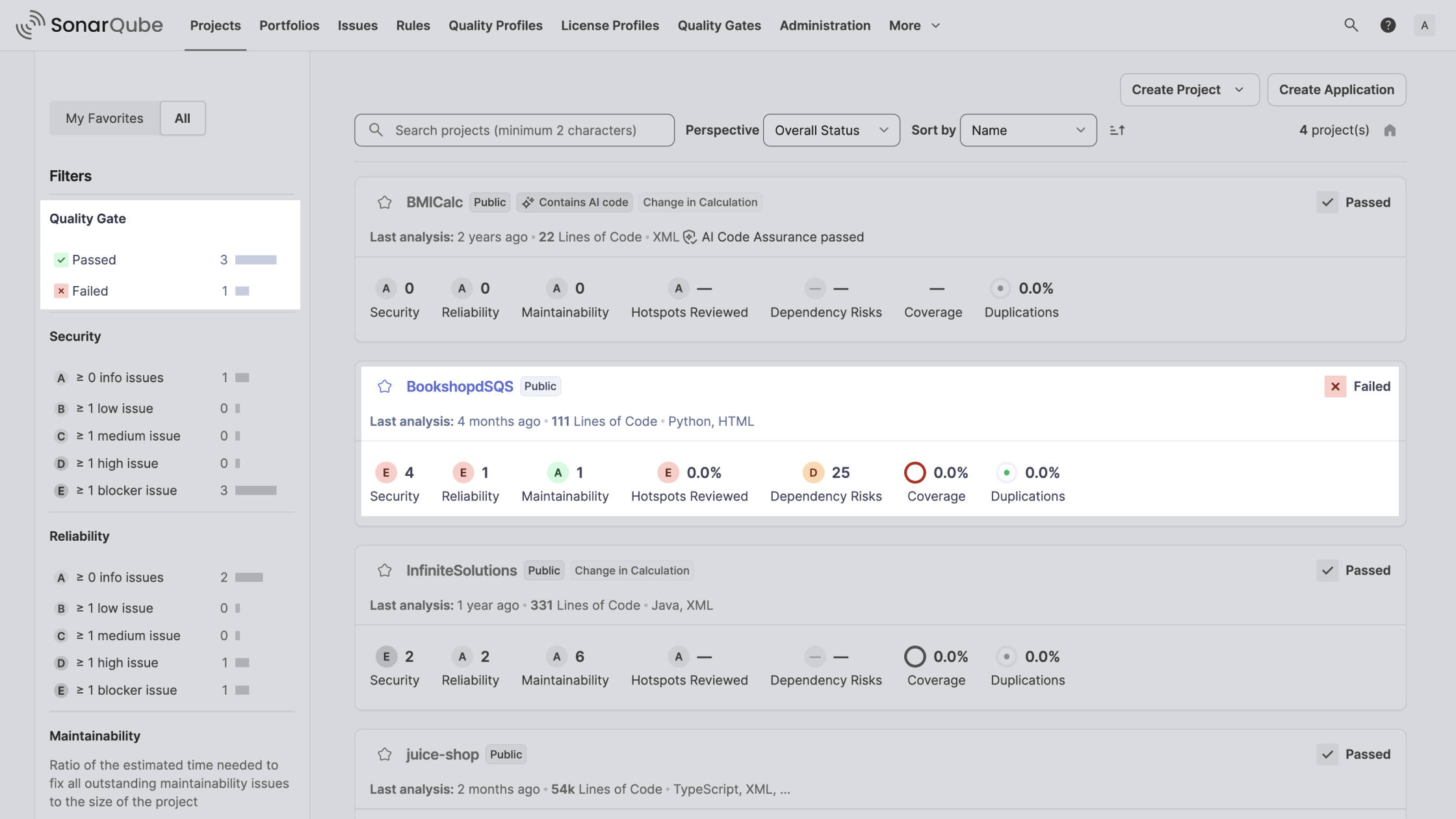
build trust
The trust and verification layer for your AI code
Find and fix issues early in the development process with deep static analysis and real-time feedback that seamlessly integrates into your existing workflow.

Quality metrics
Track maintainability, reliability, and technical debt across your entire codebase.

Security analysis
Detect complex vulnerabilities and security hotspots before they reach production.

Remediation
Automatically generate code fix suggestions with a click, minimizing manual debugging.

CI/CD integration
Seamlessly integrate with your existing development workflow and tools.
Cloud and Server
One platform. Two ways to deploy.
SaaS
SonarQube Cloud — fully managed SaaS
Elastic, cloud-native code analysis that scales instantly with your team — delivered as a service so you can focus on shipping, not infrastructure.
- Up and running in minutes
- Zero infrastructure to manage
- Automatic updates and feature rollouts
- 99.9% uptime SLA · SOC 2 Type II
Time to valueLive in under 10 minutes
Best forCloud-native teams, fast-moving DevOps
MaintenanceHandled by Sonar — you focus on code
Self-Hosted
SonarQube Server — self-managed for maximum control
Deploy inside your perimeter for full data residency and deep, deterministic security and quality insights across your entire enterprise.
- Complete data residency and privacy control
- Custom configurations and enterprise integrations
- Air-gapped deployment options available
- Dedicated support and professional services
Time to valueTailored rollout with your team
Best forRegulated industries, large enterprises
MaintenanceYou control upgrades and infrastructure
Capabilities
SonarQube capabilities
Automated code review
- Seamless integration: Integrate SonarQube into your development pipeline for comprehensive code reviews on all projects.
- Automated scanning: SonarQube automatically scans all branches, pull requests, and merges as soon as code is committed or pushed.
- Expert analysis: It applies expertly curated rules and industry compliance standards during scans.
- Real-time feedback: Receive immediate, automated feedback directly within your team’s existing code review and DevOps tools.
Static code analysis
- Streamlined workflows: Give your teams the confidence to ship secure, reliable code with streamlined workflows and minimal friction.
- Multi-language support: Static code analysis is available for over 35 programming languages and frameworks.
- Pipeline integration: SonarQube integrates directly into your development pipeline, from the IDE to the CI/CD pipeline.
- Automated detection: It automatically detects bugs, security issues, code duplications, and maintainability concerns before deployment.
Developer experience & productivity
- Fix issues in-IDE: Empower developers to find and fix issues as they code with seamless IDE integration that eliminates context switching.
- Accelerate code reviews: Enable faster feedback cycles through deep compatibility with leading DevOps platforms (GitHub, GitLab, Azure DevOps, etc.).
- Promote shared ownership: Increase transparency and align teams on quality standards using portfolio-wide dashboards and customizable Quality Gates.
Agentic code confidence


The verification and governance you need to scale agentic software factories
Autonomously clears tech debt from your existing codebase by opening verified, ready-to-merge pull requests. Each fix is scanned and verified by Sonar's engine before you see it.
SonarQube Hunter Agent
An AI-powered agent that runs a deep analysis of your SonarQube projects, hunting broken access control, business logic, and authentication flaws that traditional analysis was never built to catch.
AI CodeFix
Sonar AI CodeFix closes the loop on verification. When SonarQube flags an issue, AI CodeFix uses LLMs to suggest a one-click fix in your IDE — so findings don't just get surfaced, they get solved.
AI Code Assurance
AI-generated code should be reviewed with strict quality standards. Recommended checks should reduce code complexity, remove bugs, and eliminate injection vulnerabilities.
Security Capabilities
Developer-led code security
Empower developers with real-time, actionable guidance to detect and fix vulnerabilities as code is written and reviewed, directly in their workflow.
Static Application Security Testing (SAST)
Our SAST engine automatically finds critical vulnerabilities in your development workflow, stopping them before they reach production.
- Detect critical vulnerabilities: Identifies OWASP Top 10 and beyond — injection, authentication flaws, XSS, and more — with high precision and low false-positive rates.
- Broad language support: Covers the most popular programming languages, including Java, JavaScript, Python, C++, C#, and many more.
- Seamless workflow integration: Get immediate feedback directly in your IDE and CI/CD pipeline without context switching.
- Rapid remediation: Resolve issues faster with clear guidance and AI-powered CodeFix suggestions.
- Customizable policies: Enforce your organization’s specific security standards by creating custom detection rules.
Taint analysis
Our taint analysis engine tracks data flow to find and stop critical injection vulnerabilities.
- Find critical injection flaws: Accurately detects a wide range of vulnerabilities, including SQL injection, Cross-site scripting (XSS), SSRF, and more.
- Minimize false positives: Utilizes sophisticated cross-file and cross-function analysis to deliver highly accurate, actionable results.
- Framework-aware intelligence: Understands the native security controls in popular frameworks, leading to smarter and more relevant findings.
Secrets detection
SonarQube detects leaked code secrets throughout your development workflow, identifying them directly in the IDE and within your CI/CD pipeline.
- Comprehensive coverage: Finds API keys, passwords, and security tokens with hundreds of patterns covering all popular cloud providers and services.
- High-fidelity scanning: Goes beyond basic pattern matching, using a powerful combination of regular expressions and semantic analysis to minimize false positives.
- Customizable rules: Easily define your own patterns to detect organization-specific secrets for internal applications and private services in the Enterprise Edition.
- Shift-left detection: Get immediate feedback directly in your IDE, allowing you to remove secrets before they are ever committed to the repository.
Infrastructure as Code (IaC) scanning
Find and fix Infrastructure as Code (IaC) misconfigurations before they reach production to secure your cloud.
- Broad IaC coverage: Scans popular tools including Terraform, CloudFormation, Kubernetes, Azure Resource Manager (ARM), and Ansible.
- Identify key risks: Catches critical security issues like overly permissive access, publicly exposed services, and insecure defaults.
- Actionable remediation: Get clear, precise results with step-by-step guidance to help you fix misconfigurations quickly and efficiently.
Advanced SAST
Advanced SAST helps identify deeper and more complex vulnerabilities due to the interaction of your application code with third-party (open-source) code.
- Dependency-aware scanning: Traces data flows not just through your application, but deep into the third-party libraries it relies on.
- Uncover hidden vulnerabilities: Cross-file taint analysis that goes deep into third-party libraries for detecting hard to find vulnerabilities.
- Effortless and fast: Runs automatically with zero configuration and no performance overhead, delivering quick and accurate results.
- Language support: Currently available for Java, C#, JavaScript, and TypeScript.
Software Composition Analysis (SCA)
Secure your open-source dependencies by finding vulnerabilities, managing licenses, and inventorying your software supply chain.
- Vulnerability detection: Automatically find, track, and prioritize known vulnerabilities (CVEs) within your third-party components.
- License compliance: Check for and flag incompatible or unapproved licenses in your dependencies to avoid legal and compliance risks.
- Software bill of materials (SBOM): Generate a complete and accurate inventory of every component in your software for essential transparency and security audits.
Languages
Your programming language, covered
Coverage for dozens of the most popular languages, frameworks and IaC platforms.








What Sonar users are saying
Trusted by 7M+ developers
We’re not just keeping quality high; we’re actually able to go faster… AI makes it easier to deliver velocity, but only if you provide the right context from tools like SonarQube.
Stephen Byrnes
Distinguished Engineer
Cisco
Overall I love the tool and I’m excited to dial up our usage, particularly as tools like Claude Code gain much wider adoption and we may be forced to reckon with the quality of what we’re creating.
Eliott Weiser
Sr. Engineering Manager
Sirius XM
With over 2,000 repos, manual enforcement isn’t feasible… now, every pull request automatically goes through quality gate checks, security analysis, and secret detection.
Pravien Sammandhankumar
Head of DevOps
Freshworks
The central verification platform is how we… avoid that trade-off [between speed and safety]. It keeps the checks early. It keeps them consistent, creates visibility so the devs can move quickly.
Abhay Sharma
Head of Cloud and DevOps
Australian Unity
As we move toward using AI tooling for code generation, it is reassuring to know that all our code is checked and scanned to provide a sanity check on the quantity of code being produced.
Sarah Burgess
Lead Product Manager, Security
Xero
Gartner® names Sonar a Magic Quadrant™ Leader
AI is generating code faster than teams can govern it. Sonar was named a Leader, and placed highest on Ability to Execute. We built the verification layer the AI development cycle actually needs.
Download the report
A G2 Leader for 6 years running
4.6 / 5
What is SonarQube?
SonarQube is an industry-leading platform for automated code quality and security analysis. It enables organizations and individual developers to continuously review, monitor, and improve their codebases by detecting issues such as bugs, vulnerabilities, and code smells early in the development process. With integrations available for IDEs (via SonarQube for IDE), CI/CD pipelines, and cloud or on-premises deployments, SonarQube offers coverage for a broad range of use cases, ensuring high standards for code health and security throughout the software development lifecycle.
Trusted by over 7 million developers and 500,000 organizations globally, SonarQube provides support for more than 40 programming languages and frameworks. Its unified approach aligns developer workflows, team standards, and enterprise-grade security, making it a foundational tool for both small-scale projects and large, distributed development teams seeking scalable, actionable code intelligence.
How does SonarQube work?
SonarQube works by integrating directly into your development environment and CI/CD processes to conduct static analysis of your code. As you write code in your IDE, SonarQube for IDE (the IDE companion) performs real-time analysis to highlight issues immediately, offering explanations and quick-fix suggestions tailored to your specific context. This instant feedback loop helps developers remediate problems before code is committed.
For team and enterprise use, SonarQube synchronizes coding rules and analysis settings across IDEs and CI/CD pipelines (cloud or server-based). In connected mode, the platform ensures that everyone adheres to unified code quality and security standards, from local development through automated branch analysis and pull request reviews. Pipelines are subjected to quality gates—customizable thresholds enforcing go/no-go deployment decisions—so only code meeting set standards is eligible for merging or release.
What are the key benefits of SonarQube?
SonarQube empowers developers and organizations by providing clear, actionable feedback on code quality and security issues at every stage of the development lifecycle. Its automated code review prevents bugs and vulnerabilities from propagating, saving time and resources by reducing costly late-stage remediation and post-deployment risks. Real-time guidance and quick-fix suggestions accelerate resolution, promoting cleaner and more secure software from the outset.
Additionally, SonarQube streamlines compliance with key security standards (like NIST SSDF, OWASP, CWE, STIG, CASA) and enables team-wide consistency by synchronizing rules across IDEs and CI/CD systems. Comprehensive coverage for over 40 languages, advanced AI analysis for both human-written and AI-generated code, and robust secrets detection make SonarQube appropriate for a wide variety of organizations and industries. Its vibrant community, documentation, and support resources further enhance onboarding and continuous learning.
Is SonarQube a SAST tool?
Yes, SonarQube qualifies as a Static Application Security Testing (SAST) tool. It applies static code analysis techniques to identify security vulnerabilities, bugs, and quality issues before code is built and deployed, supporting robust application security and secure development practices. The platform’s SAST engine enables automatic and precise detection of deeply hidden security flaws, guiding developers through remediation steps directly in their workflow.
Beyond general bug detection, SonarQube incorporates advanced security features including secrets detection and compliance automation for various regulatory standards. Its SAST capabilities extend to both developer-written and AI-generated code, offering broad protection against modern vulnerabilities and risks. Combined with DevOps integration and rapid feedback mechanisms, SonarQube helps teams shift security left and maintain strong safeguards throughout CI/CD pipelines.
Is SonarQube Open Source?
SonarQube is deeply committed to open source principles, with transparency, continuous improvement, and community collaboration at its core. Users can freely access its community edition, which offers essential code quality and static analysis features suitable for individual developers and smaller teams.
For organizations requiring more advanced capabilities—such as enterprise integrations, support for compliance, enhanced security options, and scalability—SonarQube provides commercial editions (Cloud, Team, Enterprise, or on-premises Server plans). The open source edition serves as a foundational tool, complemented by a global developer community and regular contributions that drive new feature development and technical innovation.
How many programming languages does Sonar support?
SonarQube provides coverage for more than 40 programming languages, frameworks, and Infrastructure-as-Code (IaC) platforms. This includes popular languages such as Java, JavaScript, TypeScript, Python, C#, C++, PHP, Kotlin, and many more, ensuring versatility for embedded, web, mobile, and cloud-native projects.
The platform’s extensive rule library—featuring detection of over 7,000 types of coding issues—spans all supported languages and targets a comprehensive range from bugs and code smells to vulnerabilities and security hotspots. Language support is continuously updated to reflect evolving standards and best practices, ensuring robust protection and insights for diverse development stacks.
Can Sonar products analyze AI-generated code?
SonarQube and its related products actively validate AI-generated code for both quality and security. Using specialized features such as AI Code Assurance, SonarQube detects unique risks and deeply hidden issues that may be overlooked by traditional static analysis, ensuring newly generated code adheres to high standards before it reaches production.
The platform also leverages large language models (LLMs) with its AI CodeFix feature to offer one-click remediation suggestions for both AI-generated and human-authored code. This integration empowers developers to maintain control over code quality, confidently integrating generative AI solutions while mitigating potential vulnerabilities introduced by automation.
How does SonarQube ensure consistency across teams?
SonarQube helps teams maintain consistent code quality and security standards by synchronizing coding rules and analysis settings across all environments—whether in individual IDEs or within CI/CD systems. Connected mode facilitates seamless alignment, ensuring developers follow organizational policies directly during local coding and throughout automated reviews and deployments.
This centralized management means every contributor, from solo developers to large, distributed teams, works according to the same unified thresholds and rules. Quality Gates enforce minimum standards at key checkpoints, and comprehensive reporting helps monitor adherence, enabling organizations to drive continuous improvement and enforce best practices reliably at scale.
Are Sonar products suitable for individuals and enterprises?
SonarQube's product ecosystem is designed to suit both individuals and enterprises. For individuals and small teams, SonarQube for IDE (SonarLint) is free to install, providing instant feedback and essential code quality features right within the developer’s editor. The community edition and free tiers of SonarQube Cloud enable hands-on trials and personal use without upfront costs.
Enterprises benefit from advanced policy enforcement, scalable integrations, security compliance support, and the ability to monitor code quality across massive codebases and distributed teams. Commercial plans offer features for team governance, connected mode, compliance automation, and performance at scale. This flexibility ensures SonarQube solutions can grow with your organization, supporting projects of all sizes and levels of complexity.
How does SonarQube detect code quality issues, bugs, and vulnerabilities?
SonarQube utilizes a blend of powerful static analysis techniques and more than 7,000 language-specific rules to automatically detect a wide range of coding issues. As code is written or committed, SonarQube analyzes syntax, patterns, and potential logic errors, uncovering bugs, code smells, vulnerabilities, and security hotspots in real time. The platform provides clear explanations and remediation guidance for each detected issue, enabling developers to resolve problems quickly.
For broader security needs, SonarQube performs SAST scans, secrets detection, and compliance checks to flag critical risks before code is built or deployed. Integration with IDEs, CI/CD systems, and cloud or server backends means issues can be detected and fixed at every stage—empowering developers to maintain clean, safe, and high-quality code with minimal friction and maximum clarity.
How is SonarQube integrated into CI/CD pipelines?
SonarQube integrates seamlessly into CI/CD pipelines to provide automated static analysis and immediate feedback on code quality, security vulnerabilities, and compliance issues. As part of your DevOps workflow, SonarQube acts as an automated code review checkpoint—analyzing source code during build and deploy phases and decorating pull requests with actionable issue summaries. It natively supports popular platforms such as GitHub, Bitbucket Cloud, GitLab, and Azure DevOps, allowing teams to import projects in minutes and enforce “go/no-go” Quality Gates that fail pipelines when defined standards aren't met. This helps prevent problematic code from being merged or released and keeps quality and security checks front and center in the Continuous Delivery process.
Beyond just flagging issues, SonarQube’s cloud and server offerings deliver branch analysis, pull request decoration, and advanced reporting directly within CI/CD platforms. The platform also integrates with IDE plugins like SonarLint, syncing coding rules and analysis settings so that developers adhere to organizational standards both locally and in automated workflows. Combined, these features enable continuous improvement, boost development velocity, and ensure high standards for code health from commit to deployment.
What is SonarQube AI CodeFix?
SonarQube AI CodeFix is an advanced feature that leverages large language models (LLMs) to suggest one-click fixes for issues detected by SonarQube’s static analysis in both cloud and server environments. When a code issue—such as a bug, vulnerability, or code smell—is identified, AI CodeFix provides real-time, context-aware remediation options directly within the integrated development environment (IDE). This capability accelerates reliable issue resolution by offering tailored recommendations to repair flawed code, whether it’s developer-written or AI-generated.
With AI CodeFix, developers can resolve a wide spectrum of problems from simple logic errors to complex security vulnerabilities without leaving their coding workflow. The solution is designed to minimize remediation bottlenecks, streamline DevOps processes, and foster both individual and team productivity. By combining precise static analysis results with the power of generative AI, SonarQube addresses the growing complexity and pace of modern development environments.
How do I enable AI CodeFix in SonarQube?
To enable AI CodeFix in SonarQube, you first need to have SonarQube Cloud or SonarQube Server set up with the latest features, along with integration to your preferred IDE using SonarQube for IDE. Once connected, SonarQube’s static code analysis will automatically flag issues; AI CodeFix functionality will then surface actionable fix suggestions directly within the IDE, typically triggered by selection or click on the flagged problem. Activation of these features may require the use of connected mode, ensuring your IDE is properly synchronized with the SonarQube backend to benefit from unified coding rules and advanced AI capabilities.
If you are part of an enterprise setup, your organization may need to enable relevant policies or ensure your subscription includes AI CodeFix support. Users benefit from regular updates and product enhancements; it’s also advisable to review official SonarQube documentation for any prerequisites, step-by-step installation guides, or workspace-specific configuration needs. Access to AI CodeFix is intended to be as frictionless as possible, supporting efficient remediation right where developers work.
What is vibe coding and how does it differ from traditional coding?
Vibe coding basically means using AI, like those big language models, to write code for you. You just tell it what you want in regular words, and boom, it tries to make it happen. Andrej Karpathy from OpenAI came up with the term in early 2025. It's a pretty big change from writing all the code ourselves. Traditional coding tends to follow a waterfall approach with lengthy development phases, manual code reviews, and slower feedback loops, whereas vibe coding prioritizes immediate validation, fast resolution of issues, and a more intuitive, “in-the-zone,” creative workflow, often enhanced by modern IDEs and smart assistants.
This method often aligns with agile principles, integrating tooling like SonarQube for proactive code quality assurance and leveraging AI-powered suggestions to keep developers moving forward smoothly. By reducing friction, surfacing remediation insights instantly, and enabling early problem detection, vibe coding can speed up delivery cycles and enhance developer satisfaction compared to legacy workflows.
How does SonarQube help support vibe coding?
SonarQube is well-suited to support vibe coding thanks to its real-time analysis, immediate feedback, and integration with both AI-powered and traditional IDEs. Its IDE plugin (formerly SonarLint) uncovers coding issues instantly, provides quick-fix suggestions, and synchronizes team rules to create a collaborative, high-velocity coding environment. This allows developers to stay “in flow,” resolving problems as they arise without disrupting their creative momentum. The platform is designed for both human-driven and AI-assisted development, supporting the fast, iterative, and feedback-rich nature of vibe coding.
Moreover, SonarQube’s seamless connection between local coding environments and CI/CD pipelines reinforces continuous improvement and governance without adding process overhead. The combination of static analysis, AI CodeFix, and unified rule management empowers individuals and teams to deliver higher quality code faster, embodying the proactive spirit of vibe coding. By aligning technical standards, automating compliance, and accelerating remediation, SonarQube removes barriers typically faced in traditional coding, making it an ideal companion for organizations embracing modern, vibey software engineering practices.